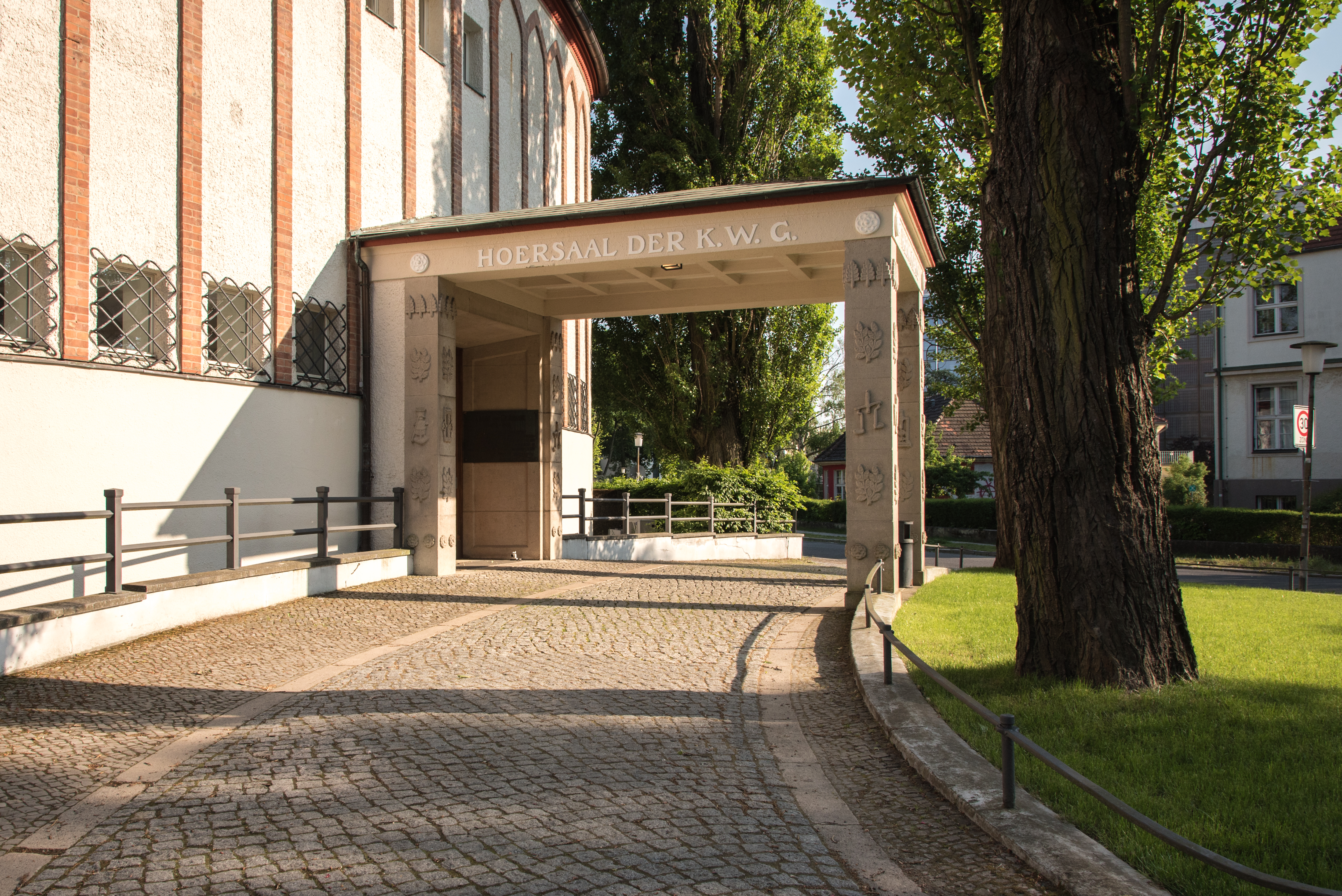
Whether in chemistry, physics or medicine – Nobel Laureates from Berlin have made lasting contributions across a wide range of disciplines. In fact, did you know that Berlin was even dubbed the “city of Nobel Prize winners” in the early 20th century? Several laureates hailed from Berlin, including Albert Einstein, Max Planck, Robert Koch and Gustav Hertz. The German capital has also been the birthplace of pioneering inventions – for example, the electron microscope was developed by Berlin physicist Ernst Ruska.
Numerous technology parks – future-focused projects and research
In Berlin, business and science work hand in hand on forward-looking projects. At the Berlin Adlershof Science and Technology Park – also known as Berlin’s “smartest Kiez” – non-university research institutes, specialist and start-up centres, and the natural sciences campus of Humboldt-Universität all come together. The technology park is home to more than 1,300 companies and 18 scientific institutions, employing over 29,000 people (as of 2025, source: Adlershof). This former manor estate has become Berlin’s most important location for science, business and media. In the BiotechPark Berlin-Buch, start-ups and established companies collaborate primarily in the field of biomedicine.
Four universities and 26 private institutions – centres of international research and education
Almost 19,000 professors, lecturers, academic staff and tutors are engaged in research and teaching across the German capital. Alongside Freie Universität and Humboldt-Universität, Technische Universität (TU) Berlin and Charité Universitätsmedizin Berlin conduct research at the highest level. Charité Universitätsmedizin Berlin is also the largest university hospital in Europe. Joint ventures such as the Berlin University Alliance and international partnerships help to strengthen Berlin’s global reputation for research and teaching.
250,000 students – Berlin as a magnet for the next generation
Of the more than 250,000 students in Berlin, 52 percent are women and over 20 percent come from abroad, primarily from India, China and Turkey. This demonstrates the international appeal of Berlin’s universities and their ideal conditions for knowledge exchange and new perspectives. (Source: Amt für Statistik Berlin-Brandenburg, 2024)
70 non-university institutions – driving innovation
Berlin is home to leading non-university research organisations such as the Fraunhofer Institute, Max Planck Society, Helmholtz Association and Leibniz Association, which focus on both basic and applied research. The scientific landscape in Berlin spans a broad spectrum of pioneering fields, including robotics and mechatronics, molecular medicine, urban development and environmental technologies.
3,000 start-ups – innovation for science
Berlin’s start-up scene is booming. The city ranks among the top 10 start-up hubs in Europe and is in the global top 20. Key sectors include the health care industry, mobility, FinTech, AI, big data and analytics.